
Expanding Presidential Powers in Federal Workforce Reductions
In recent developments that have left many legal minds and federal employees on edge, President Trump’s administration has garnered new authority to rapidly reduce the size of the federal workforce. This move, which took shape following a Supreme Court ruling, has ignited a heated debate over the balance of power between the executive branch, Congress, and the judiciary. In this editorial, we will take a closer look at the legal groundwork, the effects on various federal agencies, and the political as well as constitutional twists and turns inherent in these controversial staffing decisions.
While proponents of this decisive action argue that it is a long-overdue measure to streamline government operations, critics contend that it undermines long-standing traditions and established laws that have safeguarded workers’ rights and maintained a balance between the branches of government. Let’s dig into the heart of these issues, examining both the legal reasoning behind the Supreme Court’s decision and the potential ramifications for public services nationwide.
Legal Groundwork and the Supreme Court’s Role
At the center of the controversy lies the Supreme Court’s decision to lift a moratorium imposed by a federal judge on mass layoffs at numerous agencies. The judge’s block had been implemented in response to concerns raised by labor unions and local governments, who argued that the executive move to cut federal jobs without Congressional approval was loaded with problems and posed a threat to the democratic process.
The ruling by the high court did not resolve the broader question of whether the president truly has the lawfulness to enact such widespread staffing cuts. Instead, it provided a temporary green light, leaving the underlying issue to be decided in due course. The court’s hesitant stance and its promises to “likely affirm” the president’s authority in future rulings have left the legal community grappling with a tangled set of legal and constitutional matters.
This decision represents part of an ongoing judicial debate over the limits of presidential power. By challenging established norms, this process exposes the smaller distinctions between what is legally permissible versus what might undermine the system of checks and balances. Many legal experts are now watching closely, aware that a final decision in favor of expansive executive authority could reshape the power dynamics that have characterized U.S. governance for decades.
Impact on Federal Agencies and Affected Employees
The immediate fallout of the Supreme Court’s ruling has been significant. Federal agencies that include the Departments of Agriculture, Commerce, Energy, Health and Human Services, Justice, Labor, Treasury, State, Veterans Affairs, the Environmental Protection Agency, and the Social Security Administration are now under pressure to proceed with layoffs. This reorganization has prompted immediate concerns regarding the continuity of government services, particularly in sectors crucial to public welfare, such as tax collection, healthcare for veterans, and retirement benefit administration.
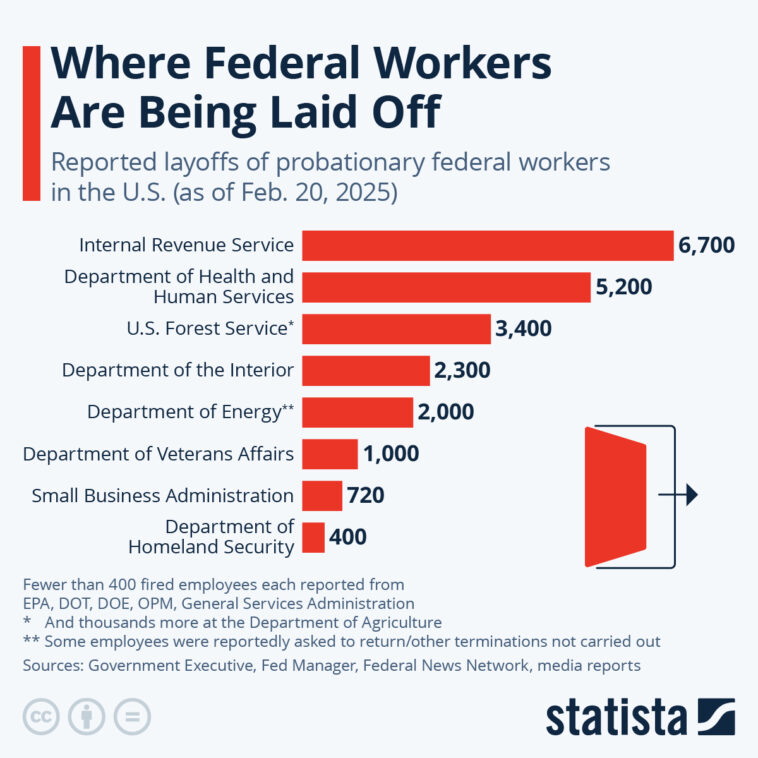
For instance, the Department of Health and Human Services, which has already announced plans to begin a layoff process affecting around 10,000 employees, could see its operational capacity severely impacted. Similarly, at the Department of Veterans Affairs—historically the largest civilian agency in the federal government—a notable wave of resignations has already been reported with expectations of further significant staff reductions in the coming months.
These layoffs are not merely numbers on paper; they represent thousands of individuals whose day-to-day lives and livelihoods are now uncertain. The potential disruption to services that millions of Americans rely on—ranging from timely tax processing to essential healthcare delivery—introduces a myriad of challenges that federal agencies will have to find their way around as they grapple with reduced human resources.
Key Concerns for Public Service Delivery
In discussing the potential impact of these staffing cuts, several pressing issues emerge:
- Service Continuity: Agencies that have historically provided uninterrupted services could face bottlenecks or delays, affecting citizens who depend on access to government resources.
- Operational Efficiency: While streamlining operations might improve efficiency in theory, the rapid implementation of layoffs risks leaving agencies with insufficient manpower during transitional periods.
- Employee Morale: The uncertainty associated with mass layoffs can lead to low morale among remaining staff, which in turn may affect productivity and service quality.
- Legal and Administrative Challenges: As agencies rush to execute pre-announced layoff plans, they could face legal challenges from workers and unions contesting the process as being loaded with problems.
Federal agencies are now waiting for detailed guidance on how to move forward with the reorganization. This uncertainty is fueled by a confluence of legal challenges that might arise over individual agency layoff plans—a scenario that could lead to multiple lawsuits and further delays. In many ways, this represents a key twist and turn as administrations try to manage their way through these intimidating legal battles while continuing to perform essential government functions.
Political and Constitutional Implications
The Trump administration’s newfound ability to enact mass layoffs without explicit Congressional consent has set off alarm bells among lawmakers and constitutional experts alike. Historically, the reorganization of federal agencies or major staffing decisions required a more balanced dialogue between the president and Congress—a safeguard that ensured any such changes would be subjected to rigorous scrutiny.
Critics argue that by sidelining Congressional oversight, the executive branch is not only bypassing a critical check and balance but also pushing its agenda in a way that few modern presidents have ever tried. This is a clear departure from the practices established during the New Deal era and modified in subsequent years. Many fear that such a move signals a broader shift toward an overly powerful presidency that could render Congress and the courts less effective in championing the will and rights of the people.
Prominent legal scholars have pointed out that while past presidents have implemented workforce reductions, doing so without Congressional input marks a significant departure from historical precedents. This reorganization strategy, characterized by its off-putting speed and scope, might well be a “workaround” intended to bypass the traditional checks—a tactic that is bound to trigger ongoing legal debates for years to come.
The Balance of Power and Its Challenges
Several constitutional experts have weighed in on the matter, stressing that the balance between the executive and legislative branches is critical to maintaining a functioning democracy. The key legal points of contention include:
- Historical Precedents: Past presidents have been allowed to make adjustments to federal organization, but always within the framework of Congressional oversight. The removal of such oversight raises questions about the preservation of constitutional safeguards.
- Executive Authority: The administration argues that the executive order, which allows agencies to “reduce the ranks” as applicable by law, is a valid exercise of presidential power—one that is fully within the legal limits as interpreted by the Supreme Court’s recent ruling.
- Judicial Oversight: With the Supreme Court’s decision yet to rule on several associated challenges, there remains a persistent tension between respecting judicial authority and enabling swift executive action.
These points illustrate the small distinctions that make the issue particularly tricky. For some, the decision is simply a legal technicality that enables a more efficient government, while for others, it represents a dangerous tilt in the balance of power that could have lasting implications for democracy.
Historical Comparisons: From the New Deal to Modern Reorganization
To fully grasp the scope of the current controversy, it is useful to compare today’s events with similar historical episodes. The broad authority exercised during the New Deal era was, at the time, seen as a necessary response to overwhelming national challenges. Presidents then were granted substantial discretion to reorganize and expand governmental functions in order to recover from severe economic downturns.
However, over the decades, the methods of such reorganization have evolved, and the role of Congress has grown more active in shaping these changes. In recent years, any significant restructuring of the federal workforce has typically involved careful consultation with legislative bodies. The current situation represents a deviation from that model—a unilateral executive decision that has sparked intense debate over whether history is repeating itself or if this is a new chapter in presidential power.
The following table contrasts key elements from the New Deal reorganization with the recent Trump-era staffing cuts:
| Aspect | New Deal Era | Trump Administration |
|---|---|---|
| Legislative Oversight | High level of collaboration and checks by Congress | Minimal direct Congressional involvement |
| Scope of Reorganization | Broad initiatives aimed at economic recovery and modernization | Rapid and dramatic reductions in workforce size |
| Judicial Involvement | Occasional challenges and long-term legal debates | Immediate legal challenges leading to Supreme Court intervention |
| Public Reception | Mixed, but generally accepted as necessary during crisis | Highly polarized, with intense scrutiny from all sides |
This side-by-side view shows the fine points that exist when comparing past reorganization strategies with today’s controversial approach. The table helps demonstrate not only the broad similarities but also the subtle differences that have led to today’s tense environment.
Union Perspectives and Worker Rights
One of the most vociferous criticisms of the administration’s approach comes from labor unions, particularly the American Federation of Government Employees (AFGE). This group, representing many federal workers, has argued that the proposed layoffs fly in the face of both established law and decades of tradition. They view the rapid move towards reducing staff as not just a political maneuver but one that is damaging to the rights and livelihoods of federal employees across the nation.
The unions have mounted legal challenges, asserting that such significant changes to federal workforce management require the explicit approval of Congress. According to union representatives, bypassing this crucial step jeopardizes the stability of the federal workforce and undermines the protections that have long been in place for government employees.
While the administration maintains that the layoffs and reorganizations are entirely lawful, unions emphasize that this strategy is full of problems: it potentially sidelines the voices of the workers and highlights dangerous hidden complexities about how workforce reductions should be handled. Furthermore, the unions warn that the widespread implementation of layoffs could set a precedent, emboldening future administrations to make sweeping organizational changes without even the traditional consultation with Congress.
Key Union Concerns
Labor unions have outlined several critical aspects that they believe are at risk:
- Job Security: Thousands of federal workers could face immediate layoffs, leading to instability and uncertainty in their careers.
- Due Process: The rapid firing of employees could circumvent established protocols designed to protect against arbitrary dismissals.
- Impact on Service Quality: A reduced workforce may lead to diminished quality and continuity in essential public services.
- Legislative Oversight: The absence of adequate input from Congress is seen as undermining the checks and balances that are critical to a healthy democratic system.
Union leaders stress that while governments necessarily adapt to changing circumstances, doing so in a way that is loaded with issues risks long-term damage to the trust between federal employees and the institutions they serve. They remain committed to the ongoing legal battles that could ultimately redefine the framework within which future administrations plan and execute such significant staffing reforms.
Administrative Efficiency versus Public Accountability
From an administrative standpoint, the justification for reorganization is often couched in terms of achieving greater efficiency. The argument posited by senior White House officials is straightforward: a leaner government is less costly and more responsive to contemporary challenges. However, this line of reasoning also brings up several tricky parts that merit closer examination.
Government agencies are tasked with providing essential services that often require continual, stable engagement with the public. The promise of improved efficiency must therefore be balanced against the public’s need for reliability and consistency. When decisions on staffing cuts are made not after a long process of consultation but through swift executive orders, the potential for disruption increases dramatically.
This approach naturally leads to a spectrum of reactions. On one side, proponents see the move as super important and a logical step toward modernizing an often bureaucratic system. On the other side, skeptics argue that such rapid reorganization is as nerve-racking as it is unpredictable—it might indeed achieve intended efficiencies, but at the possible expense of public accountability and service continuity.
Understanding the Trade-Offs
Those examining the trade-offs between efficiency and accountability highlight several key points:
- Cost Savings vs. Service Delivery: While fewer employees may translate into lower costs, the resultant strain on remaining staff and service operations can lead to inefficiencies and a decline in service quality.
- Speed of Implementation: Swift administrative action might be viewed as a demonstration of strong leadership, but it can also result in inadequate planning and execution, with unintended consequences.
- Long-Term Strategic Impact: Although a streamlined government may initially show cost savings, the long-term impact on public services and job security could be detrimental.
- Potential for Litigation: Each hastily executed layoff plan carries the risk of legal challenges that could further delay the benefits of any improvements in efficiency.
By carefully considering these points, policymakers and legal experts alike must figure a path that strikes a balance between reaping the benefits of a leaner government and upholding the principles of public accountability—a balance that has proven to be as challenging as it is critical.
Comparing International Perspectives on Executive Reorganizations
The U.S. debate on presidential power and federal restructuring is not entirely unique. In many democracies around the world, there is spirited debate over the extent of executive authority in matters of government organization and workforce management. This international context provides helpful insights that may guide the U.S. as it works through its own tangled issues.
Internationally, reforms in the public sector are often implemented with an eye toward maintaining a balance between efficiency and worker protections. For example, several European nations have instituted reforms only after extensive debates with legislative bodies and labor groups. These nations place a premium on the careful consideration of the inevitable twists and turns that come with major workforce changes.
Although the American system is distinct in its division of powers and its historical development, there are lessons to be learned from how other democracies navigate similar challenges:
- Comprehensive Planning: Many governments emphasize detailed transition plans that include stakeholder engagement and a phased implementation of reforms.
- Legislative Involvement: Broad consensus-building with lawmakers helps mitigate risks and prevents unanticipated disruptions in public services.
- Robust Legal Frameworks: Clear legal guidelines that ensure any staffing changes align with democratic principles can protect against abuses of power.
These international comparisons reveal that while the desire to modernize government is common, the pathways taken can differ widely. The U.S. approach under the current administration appears to favor speed over gradual reform, a choice that might appeal to some but alarm others who value the steady, carefully monitored evolution of public policy.
Uncertainty and the Future of Federal Employment Policy
As the debate over the president’s expanded powers continues, it is clear that the future of federal employment policy remains on edge. With many agencies already setting in motion various layoff strategies, the landscape of federal work is poised for significant change. Among the immediate questions that arise are:
- How will individual agencies manage the transition in the face of potential lawsuits?
- Will the President’s approach create a lasting precedent for future administrations?
- What measures will be put in place to ensure that essential services remain uninterrupted during the transition period?
- How might workers’ rights be preserved when the traditional avenues for negotiation are bypassed?
The answers to these questions are likely to shape public policy for years to come. The Supreme Court’s temporary decision to allow layoffs gives way to a period of significant uncertainty, as legal challenges mount and each agency must figure a path forward under new guidelines. As these events unfold, legal experts, lawmakers, and public administrators alike are watching closely to understand the hidden complexities and subtle details that will determine the process’s overall success or failure.
The sheer pace of these layoffs, combined with the legal challenges likely to follow, introduces a nerve-racking element into public administration. There is a palpable anxiety about how these changes might ripple across federal services. It illustrates a classic tension between the need for administrative efficiency and the equally super important role of maintaining stable, accountable governance.
Evaluating the Executive Order: A Closer Look at Its Provisions
The executive order, which serves as the foundation for the rapid staffing cuts, offers a number of provisions that have been subject to significant debate. The order mandates that agencies begin the process of staff reduction “to the extent applicable by law,” a phrase that has sparked considerable interpretation. Proponents argue that this gives agencies a measure of flexibility, enabling them to tailor layoff processes to their specific operational needs. Meanwhile, opponents see it as vague language that permits sweeping changes without sufficient safeguards.
Critics have pointed out several confusing bits in the order’s language, including the lack of a clear plan for retaining essential personnel, and the timing of the layoffs—some of which were initially scheduled prior to judicial intervention. This sequence of events has led many to conclude that the executive order was designed as a loophole or workaround to achieve the administration’s organizational aims while sidestepping Congressional oversight.
In dissecting the order, it becomes apparent that a number of little details merit closer inspection. Understanding the order’s legal underpinnings is key to assessing whether it stands up to constitutional scrutiny. The following points capture the fine points of the order:
- Scope of Application: The order applies to multiple agencies, which raises questions about whether a one-size-fits-all approach is truly effective.
- Definition of “Applicable by Law”: The phrase is interpreted variably across agencies, leading to disjointed implementation practices.
- Pre-existing Layoff Plans: In several cases, agencies had already devised layoff strategies prior to the judicial block. These plans are now being reactivated, adding another layer of complication.
- Judicial Intervention: The initial block by a federal judge and its subsequent lifting by the Supreme Court illustrate the ongoing tug-of-war between different branches of government.
By taking a closer look at these hidden complexities, observers gain a clearer picture of the challenges involved. The order is not merely an administrative instrument but rather a symbol of a broader struggle over executive power—demonstrating how subleties in legal drafting can carry significant implications for how power is distributed across government structures.
Legal Challenges and Upcoming Court Battles
The immediate aftermath of the Supreme Court decision has not signaled the end of legal disputes surrounding the layoffs. In fact, there is an expectation that a series of lawsuits will soon test the boundaries of the executive order’s legality on a case-by-case basis. Critics argue that by leaving room for individual agency challenges, the order remains vulnerable to prolonged litigation that could unravel the executive’s agenda.
Key aspects that are likely to be contested in future court battles include:
- Interpretation of “Lawful”: While the Supreme Court indicated that the administration was “likely to succeed,” the precise definition of what constitutes a lawful layoff process remains contested.
- Agency-Specific Approaches: Each agency’s method for reducing staff could be subject to different legal standards, a situation that may lead to varied judicial decisions across the country.
- Employee Rights Versus Administrative Discretion: The balance between guaranteeing due process for federal workers and allowing administrative flexibility is at the heart of the legal debates yet to come.
For legal practitioners and scholars alike, these upcoming challenges are a reminder that while executive actions can be swift, the justice system tends to take its time in sorting out the subtle points and little twists that underlie such decisions. With potential lawsuits looming, the Trump administration’s approach remains on a knife’s edge—a situation that could redefine presidential power for years to come.
Looking Ahead: The Future of Federal Employee Reductions
The unfolding saga of federal workforce reductions raises several critical questions about the future of public administration and the enduring balance of power within the U.S. government. With the Supreme Court’s temporary ruling in place and further legal challenges imminent, several factors will determine the long-term implications of this policy shift:
- Judicial Clarity: A final, definitive ruling on the legality of wide-scale layoffs could either cement the president’s expanded authority or force a rollback of these measures.
- Congressional Response: Lawmakers may seek to reassert their authority through legislative reforms or new oversight mechanisms in response to what they see as an overreach of executive power.
- Impact on Federal Services: The real-world consequences of these layoffs on the delivery of public services will be closely monitored, potentially influencing future policy decisions.
- Labor Union Mobilization: The continued involvement of labor groups will be crucial in protecting federal workers’ rights and ensuring any reorganization maintains due process and transparency.
These dynamic forces, working through the intricacies of legal, administrative, and political realms, will ultimately drive the future trajectory of federal employment policy. As debates heat up and the legal system sorts out the “lawful” from the “unconstitutional,” stakeholders on all sides are bracing for a period of significant uncertainty and transformation.
In the meantime, the current environment demands that agencies, employees, and government overseers work through these tangled issues while ensuring that American citizens continue to receive the public services they depend on. Whether these changes will lead to a leaner, more efficient government or result in a fragmented and under-resourced system remains a question filled with both promise and peril.
The Broader Implications for American Democracy
Beyond the immediate operational and legal questions, the administration’s actions carry deeper implications for American democracy. The expansion of presidential authority through the reorganization of federal agencies raises concerns about the concentration of power in the executive branch and the erosion of the traditional checks and balances that have underpinned U.S. governance since its inception.
This debate is more than a technical legal dispute—it touches on critical principles of democracy itself. By moving swiftly and decisively to implement layoffs, the current approach challenges the established role of Congress in shaping policy and ensuring accountability. The tension between a powerful executive and an assertive legislature has long been a defining feature of American political life, and the recent actions are likely to intensify that struggle.
Critics fear that confirming such expansive powers could set a precedent that future presidents might exploit, potentially leading to a series of unilateral executive actions that undermine democratic institutions. Conversely, supporters assert that modern challenges require robust executive action and that a well-organized, efficient government is essential for meeting the demands of the 21st century.
When considering these perspectives, it is clear that the issue extends far beyond mere staffing adjustments. It signals a potential recalibration of American democracy with far-reaching consequences for public policy, governance, and the rights of federal employees.
Long-Term Democratic Considerations
As this debate evolves, several key considerations will remain in focus:
- Presidential Precedent: How will this decision shape the actions of future presidents, and what safeguards might be necessary to keep executive power in check?
- Legislative Oversight: Could Congress respond by crafting comprehensive reform measures that clearly delineate the limits of executive reorganization?
- Public Trust: Trust in government is critical, and any perception of unchecked executive power may erode the confidence of American citizens in their institutions.
- Judicial Integrity: The role of the Supreme Court in this process underscores the importance of maintaining an independent judiciary capable of parsing the fine shades between lawful executive action and constitutional overreach.
The outcome of these longer-term discussions is likely to determine not only the operational structure of federal agencies but also the very nature of American representative government. It is a debate that is as much about the future of democracy as it is about immediate administrative efficiency.
Conclusion: A Crossroads for Federal Reorganization
In conclusion, the recent Supreme Court decision to allow the Trump administration to resume mass layoffs of federal workers represents a watershed moment in U.S. administrative law and constitutional politics. The move has set off a cascade of legal challenges, political debates, and profound questions about the appropriate balance of power between the branches of government.
The issues at stake encompass a wide range of tricky parts, from the fine details of executive orders to the broader, overwhelming implications for federal services and democratic governance. As the legal system works through the tangled issues of this unprecedented policy, federal agencies, their employees, and the American public find themselves at a crossroads—one that could redefine the nature of presidential authority for generations to come.
While the administration’s aim to create a leaner, more efficient government may hold appeal for those frustrated by bureaucratic inertia, there is an equally compelling call to preserve the democratic traditions, legal safeguards, and legislative oversight that have long been the bedrock of American governance. Finding a path that reconciles these seemingly opposed objectives is not only a legal challenge but a critical test of the resilience and adaptability of U.S. democratic institutions.
In the coming months and perhaps years, the courts, Congress, and the public will all have a role in determining whether the executive branch’s current approach to federal workforce reductions ultimately serves the nation’s best interests or becomes another source of tension in an already divided political landscape. The balance of power, the rights of federal workers, and the continuity of essential services hang in the balance as this contentious issue continues to evolve.
This period serves as a reminder that every significant shift in policy carries with it both promise and peril. As we watch these events unfold, it is incumbent upon all stakeholders to engage in thoughtful debate, consider every subtle part of the legal arguments, and work collaboratively to build a future where federal efficiency does not come at the expense of democratic accountability and worker rights.
For now, the nation remains on edge, caught between a desire for effective government reform and the equally pressing need to safeguard the time-honored democratic processes that have long defined American governance. Whether the current reorganization effort leads to a more streamlined government or creates a precedent that unduly concentrates power in the executive branch remains an open question—a question that will undoubtedly continue to shape policy discussions and legal battles in the years ahead.
Originally Post From https://www.usatoday.com/story/news/politics/2025/07/09/trump-wins-broad-authority-to-lay-off-federal-workers-without-congress/84520149007/
Read more about this topic at
Supreme Court clears way for Trump to downsize the …
Supreme Court clears way for Trump to move forward with …